Enjoy a gentle walk around the centre of Belbroughton, learning about the history of some of the most interesting and beautiful buildings in the village.
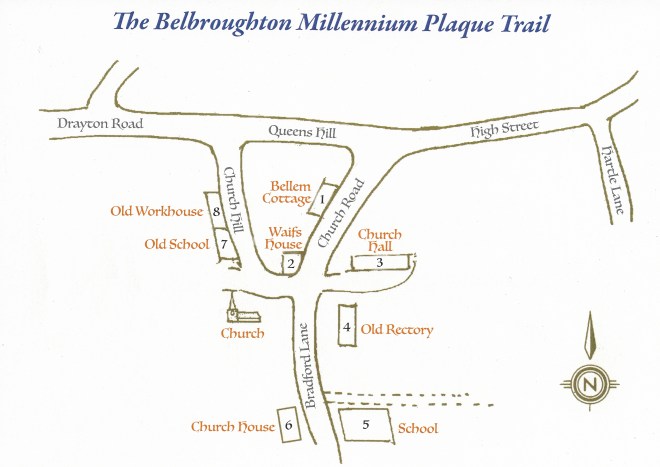
1. Bellem Cottage: Grade II listed. A 17th century timber framed building and probably one of the oldest houses in Belbroughton. By 1840 it had been divided into several small cottages but was converted back into a single dwelling in the 1950s.
2. Waifs House: Grade II listed. Late 18th century with later 19th and 20th century alterations. In 1838 Doctor Jonathan Lord Hobbes purchased the house and lived in it with his family and practised medicine there until his death in 1862. By 1880 the house was divided and the eastern end, known as Victoria House, was converted into a draper’s shop. In 1889 the rest of the house was leased to the Church of England Children’s Society and converted into a ‘Home for Waifs and Strays’. In 1890, 15 girls ‘rescued from vicious surroundings’ lived there. The home closed in 1910. In 1950 the house was remodelled to the home we see it today. The former malthouse, now 17 Church Hill, was converted into a separate building. Part of it had probably been used as the Home’s laundry.
3. Church Hall: Grade II listed, early 17th century. It was originally a parish tithe barn. (Tithes were payments of one tenth of all annual produce from eligible parishioners to the Rector.) The building deteriorated in the 19th century and in 1911 it was scheduled for demolition. But instead, it was decided to restore it and convert it to a hall for the benefit of the community and in 1915 it was handed over to the village. The beautiful hall had a full refurbishment in 2023 and is run by a committee of volunteers.
4. Old Rectory: Grade II listed, mid 18th century. The central block predates the wings which were added at the end of the 18th century. The placing of the door at one end of the central block is unusual – Georgian architects liked symmetry. There is evidence that the site has been occupied by the clergy since the 16th century. In the 1970s the rectory was sold and became a private dwelling. A new Rectory was built in the former orchard in the 1980s.
5. Belbroughton C of E Primary School: The school dates from 1874 and is built from local red brick, decorated with courses of blue brick in the Victorian style. To meet the requirements of the 1870 Education Act better facilities were required and the old school was struggling to cope with its 190 pupils. Rector Henry Woodgate led an appeal to raise £1000 to build the school. The Old Queens Head Inn was demolished to make way for the new school.
6. Church House: Grade II listed, late 18th century. Church House is different from any other building in Belbroughton. The building is rendered 3 stories high and built in the domestic Gothic revival style, a reaction against the Georgian symmetrical style. We have no idea who built the house but the facade conceals an earlier building dating before 1759.
7. Old School House: Not listed but believed to date from the middle of the 18th century. The building was the first known school in 1750 when the parish received a legacy of £100 for the benefit of the ‘Free School’. At the end of the 18th century Rector G W Blakiston was taking a keen interest in the school and devised rules for the school including ‘to teach 26 charity children with utmost discipline and expedition to read, write and say the Catechism’. By 1840 there were 70 boys attending and in about 1850 the building was extended to include girls. By 1870 the numbers had increased dramatically and the new school was built. The old school remained for girls and infants and from 1913, for infants only. The old school finally closed in 1963 and became flats and in the 1980s it was converted back to a single dwelling.
8. Old Workhouse: The date of the building is not known and it is not listed. From 1824-1837 it was the Parish Workhouse accommodating up to 28 people classed as ‘the poor, the elderly, the infirm’. From the turn of the 17th century national legislation had passed the care of these poor unfortunates to the local communities and parishes. Workhouses were seen as the solution to this problem. By 1834 these laws were seen to be too benevolent and the New Poor Law set up a harsher regime. In 1837 the occupants were transferred to the Bromsgrove Union. The building became a public house, the New Inn, and in 1979 it became a restaurant, Freshmans. In 2002 it became a private house.
 Belbroughton History Society